Overview: New US Tariffs on Indian Exports (2025)
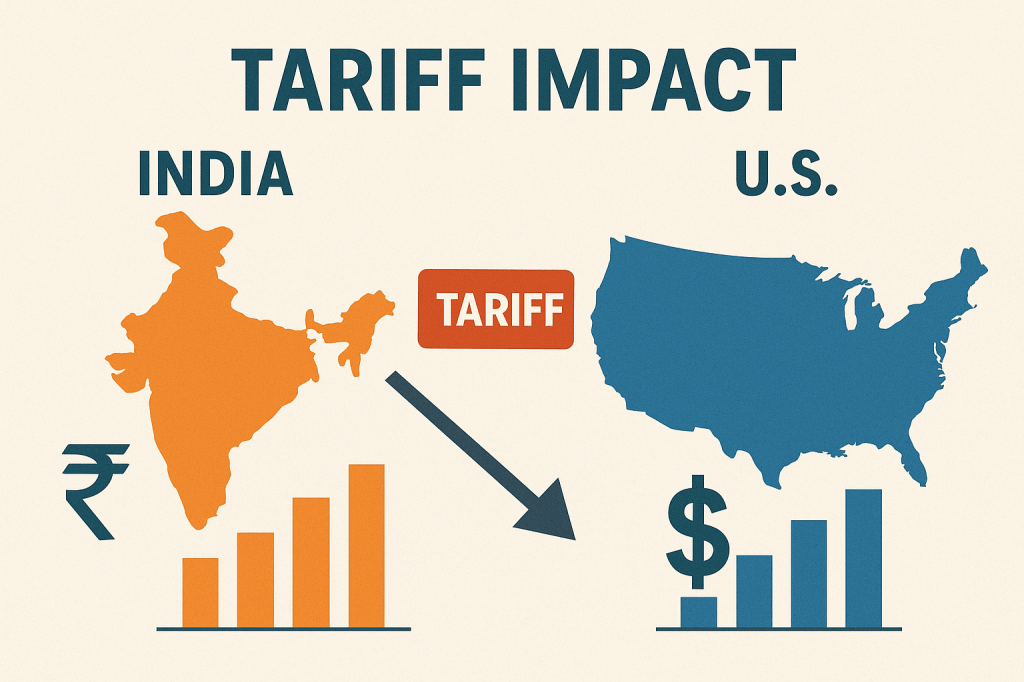
Recently in 2025, the US administration increased tariffs on a range of Indian goods by an additional 25%, raising the total tariff level to 50% for most of the products. This move followed an initial 25% tariff imposed on 1st of August 2025, and they targets India’s continued imports of Russian oil. The tariffs apply to about 55% of India’s merchandise exports to the US, which is India’s largest single-country export market, accounting for roughly $87 billion – This contributes about 2.5% of India’s GDP. As US is the biggest export market for Indian Market, it become important for everyone to understand the impact of These Tariffs on India, its GDP and People like US. We can’t deny the fact that if this tariff will continue it will impact the Indian exporters and people directly and indirectly. But as we all know that Indian market have a strong domestic demand and consumption which can help India and its market to sustain the impact.[1][2][3]
Key Figures & Macroeconomic Impact
- Exports at Risk: India sends $87 billion worth of goods to the US annually. This is about 2.5% of India’s GDP. And as we know that around 50-55% of export to US will get impacted so approx. $48–55 billion of Indian exports to the US will be directly affected by this increase in tariffs.[2][1]
- Estimated Export Drop: Engineering exports could fall by $4–10 billion; overall US-bound exports may be slashed by half if tariffs persist. And mostly affected sectors will be engineering goods, gems, chemicals, textiles etc.
- GDP Growth Reduce: Tariffs are likely to reduce India’s GDP growth by 0.5–0.8% (from a forecast of 6.5% down to as low as 5.5% for FY26). For FY27, growth could reduce a further around 0.4 percentage points.
- Stock Market Effects: Sectors with major US exposure—like textiles, gems and jewellery, autos, and engineering-faced marked stock pressure, while IT services, FMCG, and banking remained more stable due to limited dependency on US exports.
- Sectors with exemption: Pharmaceuticals, Electronics, Semiconductors, Energy products (critical minerals/crude/natural gas).[4][1][2]
Statistical Impact by Sectors
India exports a variety of goods to the US, but the new tariffs disproportionately impact several key sectors. Here’s a sector-wise breakdown:
| Sector | Current Export Value to US (2024-25 est.) | % of US-bound Exports at Risk | Tariff Rate (2025) | Expected Impact |
| Textiles & Apparel | ~$9.5B[1] | High | 50% | Significant reduction in competitiveness, potential $1.5–2B loss[1][4][3] |
| Gems & Jewellery | ~$12.4B[1] | High | 50% | Major hit, likely $2B+ export loss[1][4][5] |
| Leather & Footwear | ~$1.2B[1] | High | 50% | Loss of market share; lower margins |
| Chemicals | ~$6.8B[1] | Moderate | 50% (organic/selected) | Margins squeezed, may see $500M+ fall[1][6] |
| Auto Components | ~$5B[1] | High | 50% | $0.5–1B drop expected |
| Marine Products | ~$1.6B[1] | Moderate | 50% | Sharply lower demand |
| Steel & Aluminium | ~$1.1B[6] | Moderate | 25–50% | Lower shipments; select codes exempt |
| Furniture | ~$800M[1] | High | 50% | ~20–30% contraction likely |
| Dairy Products | ~Undisclosed (small) | High | 81.5% (buttermilk), 55.8% (milk powder)[1] | Negligible exports; impact marginal |
| Pharmaceuticals | ~$6.7B[1][2] | Low (APIs exempt) | 0% | No impact; sector protected |
| Electronics/Semiconductors | ~$11.2B[1][2] | Low | 0% | No impact; sector protected |
| Energy/Crude/Natural Gas | ~$4B[1][2] | Low | 0% | No impact; sector protected |
Note: Export values are for FY2024–25 and are rounded-off for ease of comparison.
Key Sector Details
- Textiles & Apparel: Indian companies face sharp competition from Vietnam and Bangladesh, who are subject to lower US tariffs. Exporters warn of a major blow to margins and market share, especially for labor-intensive businesses.[7][8][1]
- Gems & Jewellery: Will see a sharp drop in competitiveness; projected export loss of up to $2 billion.[5]
- Engineering Goods: Includes machinery, electrical and auto components; potential loss $4–5 billion.[1][5]
- Auto Components: Will incur price disadvantages, projected $0.5–1 billion drop.[4][1]
- Pharma & Electronics: Protected due to exemptions; export volumes expected to stay stable.[6][2][4]
Broader Economic Reactions

- MSME Vulnerability: Textiles, chemical, engineering, leather etc. are the sectors dominated by MSME’s and these sectors are mostly exposed to risk and will have heavy job losses and closures.
- Rupee & Inflation: Tariff increase is affecting rupee negatively and hence rupee is getting weaker in offshore trading and it keep worsening the outlook for foreign debt and stoking risks of imported inflation.
- Investor Sentiment: Foreign Institutional Investors (FIIs) likely to lower exposure, with volatility in export-heavy indices.
- Market Volatility: Negative short-term sentiment and underperformance for mutual funds and ETFs holding export sector stocks.
Contrarian/Offsetting Insights
- Some analysis suggests that 75% of the tariff burden will impact the US businesses and consumers, which will reduce the impact on India directly. And this tariff will increase the inflation for Americans.
- India’s economy is less reliant on exports, with domestic consumption and investment remaining strong-so long-term sovereign ratings are not threatened.
Summary Table: US Tariffs Impact on Indian Exports (2025)
| Sector | Tariff Rate | Current US Export Value | Estimated Export Loss/Impact |
| Textiles/Apparel | 50% | ~$9.5B[1] | $1.5–2B[1][4][3] |
| Gems/Jewellery | 50% | ~$12.4B[1] | $2B+[1][5] |
| Auto Components | 50% | ~$5B[1] | $0.5–1B[1][4] |
| Chemicals | 50% | ~$6.8B[1] | $500M+[6] |
| Engineering Goods | 50% | ~$13B[1] | $4–5B[1][5] |
| Pharma/Electronics | 0% | ~$17.9B[1][2] | No impact[6][2][4] |
Summary Table: Export Loss & Growth Change
| Indicator | Value | Source(s) |
| Exports to US (annual) | $87B | [1][2] |
| Share of GDP | 2.5% | [1][2] |
| US trade deficit (vs India) | $45.7B | [1] |
| Engineering export loss | $4–5B | [1] |
| GDP growth reduction | 0.2–0.5% (FY26) | [2] |
| Stock market reaction | Volatile | [1][3] |
Summary:
In summary, the US’s sharp tariff hikes threaten more than half of India’s export value to its biggest trading partner, with the greatest pain felt by textiles, gems, apparel, engineering, and auto parts sectors. Pharmaceuticals, electronics, and energy products remain protected from this trade shock. So our takeaway will be following:
- Short-term: Severe pressure on export industries, job losses, rupee weakness, and moderate GDP growth cut are expected.
- Medium term: If tariffs persist, export-heavy sectors will underperform and economic growth will slow modestly (but not collapse).
- Long-term: India remains resilient due to strong domestic factors, with sovereign ratings unaffected; most export pain concentrated in textiles, jewellery, leather, chemicals, and marine products[7][2][1].
Citations:
- https://cleartax.in/s/us-tariff-on-india
- https://www.businesstoday.in/india/story/us-imposed-25-reciprocal-tariffs-on-indian-exports-no-addl-tariffs-on-pharma-electronics-mos-commerce-489039-2025-08-12
- https://economictimes.com/news/economy/policy/trump-tariff-blow-set-to-ripple-through-indias-economy-and-banks-fitchs-creditsights/articleshow/123293630.cms
- https://afleo.com/understanding-the-impacts-of-us-tariffs-on-indian-exports-a-2025-outlook/
- https://economictimes.com/news/economy/foreign-trade/negligible-impact-of-us-tariffs-on-indias-gdp-exports-study/articleshow/123140334.cms
- https://www.icra.in/Rating/DownloadResearchSpecialCommentReportViewer/6277
- https://www.bbc.com/news/articles/c1w83j35jjjo
- https://www.chathamhouse.org/2025/08/trumps-tariffs-put-strain-us-india-ties-relations-will-endure-long-run


 goforbooks.com
Leave a comment