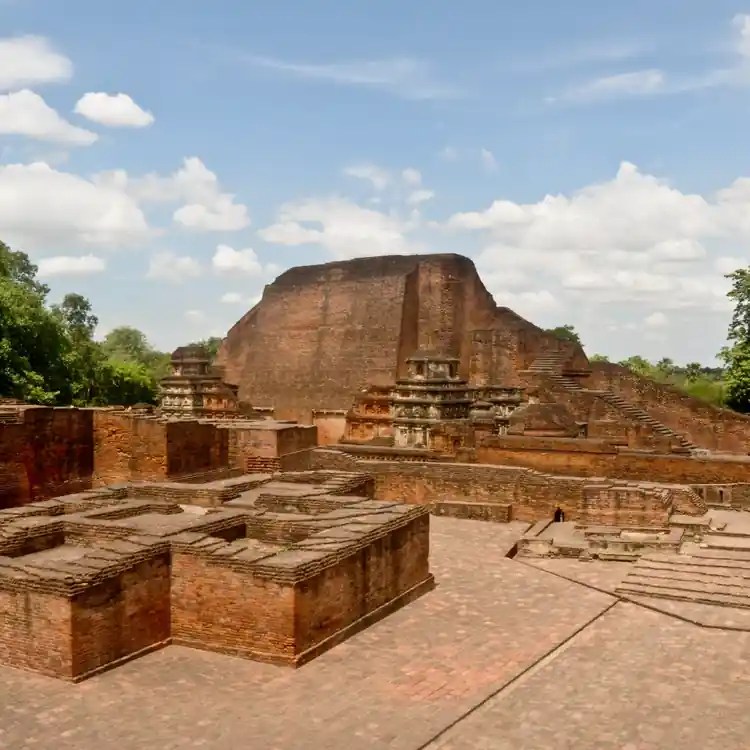
Nalanda University was Established in the 5th century CE; itwas the world’s first residential international university. Located in the ancient kingdom of Magadha (modern-day Bihar, India), it served as a global beacon of knowledge for over 800 years.
🏛️ Historical Timeline
Nalanda’s history is a saga of intellectual dominance, royal patronage, and ultimate tragedy.
- Foundation (427 CE): It was established by Emperor Kumaragupta I of the Gupta Dynasty. The Guptas, known for the “Golden Age of India,” provided the initial liberal culture and resources for its growth.
- Golden Era (5th–12th Century): The university flourished under subsequent dynasties, including the Pushyabhuti (under King Harshavardhana) and the Pala Empire. During this time, it attracted roughly 10,000 students and 2,000 teachers from across Asia, including China, Korea, Japan, Tibet, and Persia.
- The Destruction (c. 1193 CE): The university was sacked by Bakhtiyar Khilji, a general of the Delhi Sultanate. Legend says its massive library, Dharma Gunj (Mountain of Truth), contained so many manuscripts (roughly 9 million) that it burned for three months after being set on fire.
🎓 Importance and Curriculum
Nalanda was not just a religious school; it was a comprehensive center for higher learning that predated the University of Oxford by several centuries.
1. Global Academic Hub
It was the first institution to have a formal entrance exam. Scholars like Xuanzang and I-Qing traveled thousands of miles from China to study and document the university’s rigorous academic life.
2. Diverse Subjects
While its core was Buddhist philosophy (Mahayana and Hinayana), its curriculum was incredibly diverse:
- Science & Math: Home to scholars like Aryabhata (believed to have headed the university), who pioneered the concept of zero.
- Medicine: It was a major centre for Ayurvedic studies and surgery.
- Arts & Humanities: Courses included Grammar, Logic (Hetuvidya), Astronomy, and Alchemy.
3. Architectural Marvel
The campus was a feat of ancient engineering, featuring:
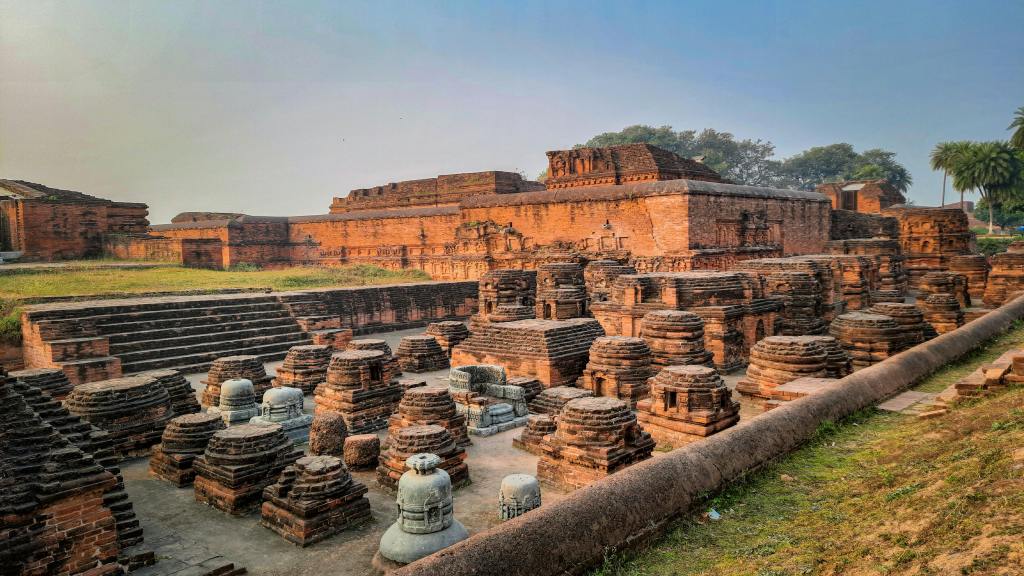
- Eight distinct compounds and ten temples.
- Nine-story libraries (Ratnasagara, Ratnodadhi, and Ratnaranjaka).
- Advanced water systems and meditation halls designed for thousands.
🌟 Modern Revival
In 2010, the Government of India passed the Nalanda University Act to revive the ancient seat of learning.

- New Campus: A modern, “Net-Zero” green campus was established near the original ruins in Rajgir.
- International Collaboration: It is supported by 17 participating countries (including China, Australia, and Singapore) as part of a diplomatic effort to reconnect Asian cultures.
- Inauguration: Prime Minister Narendra Modi officially inaugurated the new campus in June 2024, marking a symbolic rebirth of the ancient institution.
Building on its storied history, Nalanda’s true legacy lies in the profound intellectual frameworks it developed and the legendary polymaths who walked its halls.
🧠 Core Philosophies and Schools of Thought
Nalanda was the epicentre of the “Nalanda Tradition,” which emphasized logic, reason, and a deep psychological analysis of the mind.
- Madhyamaka (The Middle Way): Founded by Nagarjuna, this school focused on Shunyata (emptiness)—the idea that all things lack an inherent, independent essence and exist only in relation to other things.
- Yogacara (Mind-Only): This school, championed by Asanga and Vasubandhu, posited that reality is a projection of consciousness. It led to advanced studies in psychology and the “storehouse consciousness.”
- Logic and Epistemology (Pramana): Nalanda was famous for its “Lion’s Roar” debates. Scholars like Dignaga and Dharmakirti established the rules of Indian logic, which are still studied today in Tibetan monastic universities.
- Vajrayana (Tantric Buddhism): In its later years (8th century onwards), Nalanda became a pioneer in Tantric studies, which eventually traveled to Tibet through masters like Padmasambhava and Atisha.
🎓 Legendary Scholars and Their Discoveries
The university was led by a Kulapati (equivalent to a Vice-Chancellor). These individuals weren’t just monks; they were pioneers in science and philosophy.
| Scholar | Contribution / Discovery |
| Aryabhata | Often cited as a head of Nalanda, he calculated the value of $\pi$ to four decimal places ($3.1416$) and correctly stated that the Earth rotates on its axis centuries before Galileo. |
| Nagarjuna | Known as the “Second Buddha,” he developed the philosophy of Emptiness and is credited with early works on Alchemy (Rasaratnakara) and medicine. |
| Dharmapala | A brilliant logician and former abbot who defended the university’s teachings against challengers from across India. |
| Silabhadra | The venerable abbot who personally taught the Chinese traveler Xuanzang. He was said to have mastered all the collections of Buddhist and Brahmanical scriptures. |
| Vasubandhu | Wrote the Abhidharmakosa, an encyclopedic work on Buddhist metaphysics that remains a standard textbook in East Asian Buddhism. |
🌍 Why it Matters Today: The “Nalanda Trail”
Nalanda’s importance isn’t just historical; it is a vital link in the shared heritage of Asia.
- Preservation of Knowledge: When the university was destroyed, many scholars fled to Tibet and China with manuscripts. Much of what we know about ancient Indian philosophy today survived only because it was preserved in Tibetan and Chinese translations of Nalanda’s texts.
- The Scientific Method: The university’s emphasis on “Vada” (debate) and “Pramana” (proof) is considered a precursor to the modern scientific method—where nothing is accepted as truth unless it passes the test of logic and observation.
- Cultural Diplomacy: The modern revival of Nalanda serves as a “Soft Power” bridge, connecting India with ASEAN and East Asian nations through their shared intellectual roots.
📉 The Fall of Nalanda (1193 CE)
The destruction of Nalanda was not just the end of a building, but the “end of an era” for classical Indian science and philosophy.
- The Invader: Bakhtiyar Khilji, a Turko-Afghan military general, attacked Nalanda while looking to consolidate power in the Bengal and Bihar regions.
- The Library Fire: The library complex, known as Dharma Gunj (Mountain of Truth), was so vast that it reportedly burned for several months. Thousands of irreplaceable manuscripts on medicine, astronomy, and philosophy were lost forever.
- The Human Toll: Thousands of monks were killed or fled. The survivors took what few scrolls they could carry and escaped to Tibet, Nepal, and Bhutan, which is why many “lost” Indian texts now only exist in Tibetan translations.
📜 The Records of Xuanzang (Hiuen Tsang)
Much of what we know about the daily life of Nalanda comes from the travelogues of the Chinese monk Xuanzang, who studied there for five years in the 7th century.
- The Admission Test: He recorded that the “gatekeepers” (professors) would ask difficult questions of prospective students at the entrance. Only 20% to 30% of applicants were intelligent enough to pass and enter the university.
- Daily Life: He described a rigorous schedule starting at dawn, signaled by the beating of a drum. Students engaged in “endless debate” in the courtyards.
- Awe-Inspiring Beauty: He wrote of deep blue lakes with red lotus flowers and towers that “seemed to be lost in the mists of the morning.”
🏗️ The Modern Reconstruction (2010 – Present)
The idea to revive Nalanda was first proposed by former Indian President Dr. A.P.J. Abdul Kalam in 2006.
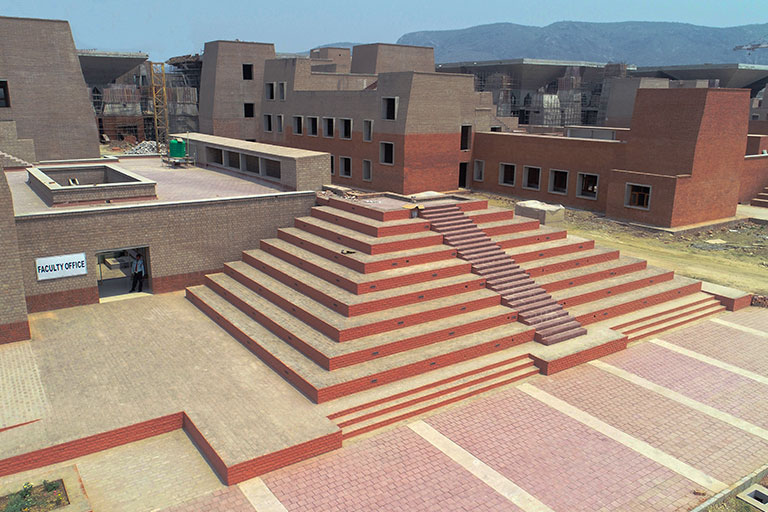
The New Campus (Rajgir)
- Sustainability: The new campus is a “Net-Zero” facility. It uses an ancient cooling system called the Desi (indigenous) system, involving massive water bodies and thick walls to regulate temperature without heavy air conditioning.
- Architecture: The design echoes the original red-brick aesthetic of the ruins while incorporating modern glass and steel.
- International Backing: It is an international university supported by the East Asia Summit (EAS), with contributions from countries like Japan, Singapore, and Australia.
Comparison: Ancient vs. Modern
| Feature | Ancient Nalanda | Modern Nalanda (Current) |
| Established | 427 CE | 2010 (Inaugurated 2024) |
| Focus | Buddhist Philosophy, Logic, Science | Ecology, History, Management, IT |
| Primary Language | Sanskrit / Pali | English |
| Student Body | 10,000+ | Growing (International) |
🗺️ The Nalanda Trail: A Living Legacy
Today, the ruins are a UNESCO World Heritage Site. Walking through the site, you can still see the:
- Monastic Cells: Small rooms where students lived and meditated.
- Kitchens: Massive ovens capable of feeding thousands.
- Sariputra Stupa: The most iconic structure on the site, dedicated to one of the Buddha’s chief disciples.

 goforbooks.com
Leave a comment